Introduction
A slip on the stairs. A fracture on the soccer field. A late-night ER visit for stitches. The medical bill is only part of the story.
There's also the cab ride home, the missed shifts, the childcare you suddenly need while you're on crutches. Accident insurance is built for that second layer of cost.
It's a supplemental policy that can pay a fixed cash benefit after a covered accidental injury. It is not a substitute for major medical health insurance, and it won't pay every bill you receive.
This article breaks down what these plans typically cover, where they fall short, how pricing works, and how to figure out if one actually fits your situation.
Key Takeaways
- Accident insurance pays cash benefits for qualifying injuries, based on a fixed benefit schedule, not your medical bills
- Payouts go to you, the policyholder, to use however you need
- Coverage, exclusions, and premiums vary widely by insurer, state, and plan design
- Accident insurance works alongside health insurance, disability coverage, and hospital indemnity plans, not instead of them
What Is Accident Insurance and How Does It Work?
Accident insurance is a supplemental health product. It's designed to soften the financial hit from a covered accident, not to function as your primary medical plan.
Claims usually follow this sequence:
- An accidental injury occurs — a fracture, burn, concussion, or similar event
- You receive treatment at an ER, urgent care, or hospital
- You submit documentation — bills, treatment records, proof of the accident
- The insurer reviews the claim against its benefit schedule and definitions
- An approved benefit is paid, typically direct to you

Fixed Cash, Not Full Reimbursement
This is the part most people get wrong. Most accident plans don't reimburse your actual medical bill. Instead, they pay a stated dollar amount tied to a specific injury or service.
Break your arm, and the policy might pay a set amount for the fracture, another set amount for the ER visit, and possibly another for a follow-up visit. Add them up, and that's your payout, regardless of what your hospital actually charged.
Because the money goes to you directly, it can cover:
- Health plan deductibles or copays
- Transportation to appointments
- Childcare while you recover
- Groceries or household bills if you're missing work
The Fine Print That Actually Determines Your Payout
Before assuming a plan will help, check:
- The benefit schedule — the exact dollar amounts for each injury or service
- Definitions — what counts as a "covered accident" under that specific policy
- Waiting periods and claim deadlines
- Proof-of-treatment requirements
- Riders that add or limit coverage
Accident insurance generally does not replace health insurance or satisfy minimum essential coverage requirements, so keep your primary medical plan in place.
What Does Accident Insurance Cover—and Not Cover?
Coverage categories vary by carrier, but common benefit types include:
- Emergency room and urgent care treatment
- Ambulance transport (ground and air)
- Hospital admission or confinement
- Diagnostic imaging (X-rays, CT scans)
- Fractures, dislocations, burns, and lacerations
- Concussions
- Physical therapy and durable medical equipment
- Emergency dental treatment
Some policies layer on wellness benefits, rehabilitation coverage, or accidental death benefits. Whether any of these apply depends on your certificate and schedule of benefits—not a generic feature list.
Treated ≠ Covered
Here's a distinction that trips people up: being treated for an injury and having that injury qualify for a scheduled benefit are two different things.
Example: Two people each break a wrist. One person's plan pays $1,000 for a closed fracture requiring a cast. The other person's plan only pays for fractures requiring surgery, and their break didn't need surgery. Same injury, same treatment, completely different payout, because the policy language differed.
Common Exclusions to Watch For
Most accident-only policies exclude:
- Illness-related treatment (this covers accidents, not sickness)
- Intentional self-harm
- Injuries related to intoxication or drug use (with some stated exceptions)
- War or acts tied to criminal activity
- Injuries from excluded sports, hobbies, or occupations
- Pre-existing condition limitations
- Cosmetic treatment
- Treatment that doesn't meet the policy's timing or provider requirements
State-specific provisions, benefit caps, and claim time limits can also change what you collect. Go straight to your policy's exclusions, definitions, and claim instructions—that is the only version that matters for your coverage.
How Much Does Accident Insurance Cost and Where Can You Buy It?
Premiums swing based on several factors:
- Individual versus family enrollment
- Benefit level selected
- Age and state of residence
- Plan design and available riders
- Whether the plan is guaranteed-issue or medically underwritten
- Employer-sponsored versus individually purchased
What Pricing Examples Actually Show
One carrier's published rate sheet (dated May 2025) listed these monthly examples for ages 18 to 75:
| Enrollment Tier | Monthly Example |
|---|---|
| Individual | $26.99 |
| Named insured + spouse | $37.95 |
| One-parent family | $44.91 |
| Two-parent family | $57.09 |

That same insurer notes elsewhere that monthly premiums can range from a few dollars to more than $50 depending on coverage type and how many people are covered. Treat these as illustrations from one carrier at one point in time, not a national average. Your quote will differ based on your state, age, and plan design.
Where to Buy Coverage
You generally have three paths:
- Employer-sponsored enrollment — often during open enrollment, sometimes with guaranteed acceptance
- Individual purchase — direct from an insurer, with state-specific availability
- Through a licensed advisor — who compares options across your specific situation
Some insurers do allow you to apply for accident insurance online. Others require a licensed advisor's involvement, particularly if your state has specific enrollment or underwriting rules. Before buying online, confirm:
- The insurer's identity and state licensing
- The actual policy documents (not just a marketing summary)
- Exclusions and benefit caps
- Renewal and cancellation terms
- Whether the coverage matches your actual risk exposure
This is where a second set of eyes helps. Blake, a licensed insurance advisor at Blake Health Plans, works with individuals, families, self-employed professionals, contractors, entrepreneurs, and small business owners nationwide.
He compares supplemental accident coverage options in plain English, filtered against your ZIP code, budget, and life stage, so you're not guessing which plan actually fits.
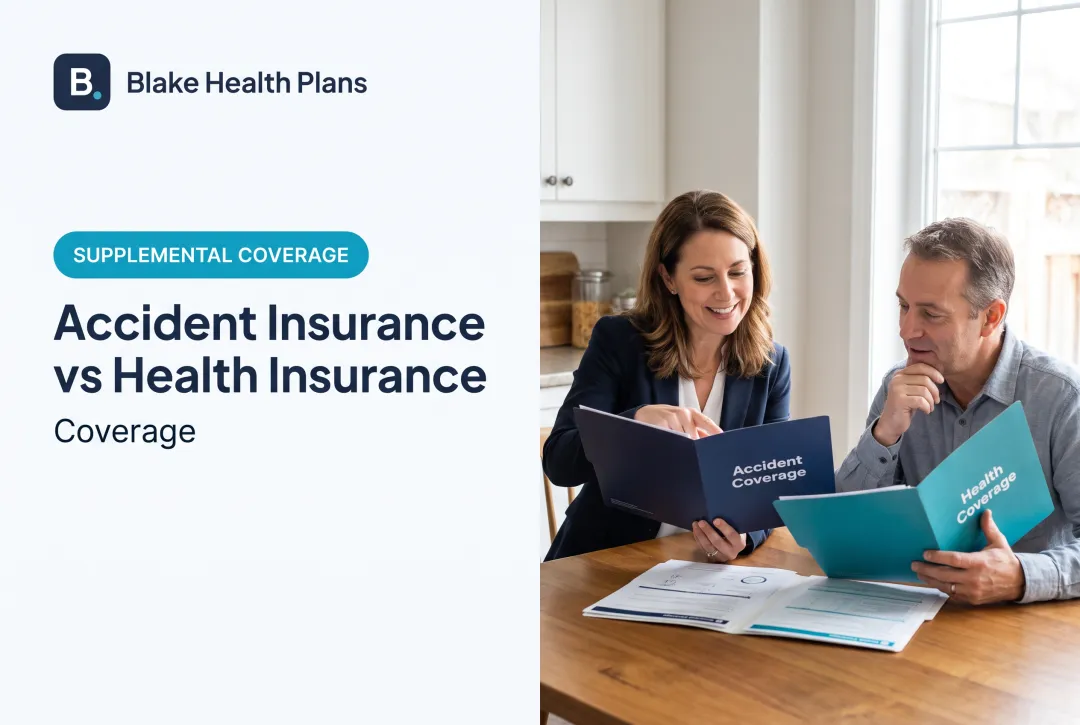
Accident Insurance Compared With Other Types of Coverage
Accident insurance solves a narrow problem. Compare it with related coverage before you add another policy on top of what you already have.
| Coverage Type | What Triggers a Payout | Best For |
|---|---|---|
| Accident insurance | A covered accidental injury or specified treatment | Filling gaps after an unexpected injury |
| Health insurance | Covered medical care, generally cost-shared after a deductible | Ongoing and comprehensive medical needs |
| Disability insurance | A qualifying disability that prevents work | Replacing lost income over time |
| Hospital indemnity | A qualifying hospital stay or admission | Costs tied specifically to hospitalization |
| AD&D | Accidental death or a specified severe loss (dismemberment, paralysis) | Catastrophic outcomes, not everyday injuries |
Key differences:
- Health insurance manages your ongoing medical costs. Accident insurance pays a scheduled amount only after a qualifying accident.
- Disability insurance replaces income during a qualifying disability. It's not triggered by a single ER visit the way accident insurance can be.
- Hospital indemnity needs a hospital stay to trigger payment. Accident insurance can pay out even if you're treated and released the same day.
- AD&D is built around death or catastrophic loss, not routine injuries like a sprained ankle.
Before layering on a supplemental policy, check what you already have. Overlapping benefits mean you might be paying twice for coverage of the same event. Review your existing employer benefits, deductibles, and emergency savings first.
How to Choose an Accident Insurance Plan—and Decide Whether It Is Worth It
Start with your actual financial exposure, not the policy brochure. Ask yourself:
- How much do I have in emergency savings right now?
- What's my health plan's deductible and out-of-pocket maximum?
- Do I have paid leave if an injury keeps me out of work?
- Would workers' compensation apply to my situation?
For context: employer health plans in 2025 carried average single-coverage out-of-pocket maximums of $4,926 for HDHP/HRA plans and $4,509 for HSA-qualified HDHPs, according to KFF's 2025 Employer Health Benefits Survey. Accident insurance is built to help offset that kind of gap—though your own plan's numbers may differ.
When Coverage May Be Worth Considering
- Active households with kids in sports or high injury-risk hobbies
- Limited emergency savings on hand
- High cost-sharing under your current health plan
- Inconsistent or no paid sick leave
- Self-employed or contract work without employer-provided benefits
When It May Add Limited Value
- A tight budget where premiums compete with essential coverage
- Strong emergency reserves already in place
- Substantial existing supplemental benefits through an employer
- Narrow policy definitions that wouldn't cover your realistic risks
In the Federal Reserve's 2024 household survey, 63% of adults said they could cover a hypothetical $400 emergency expense with cash or its equivalent. If you're in that group, a modest accident policy may matter less. If you're not, the calculus shifts.

A Practical Comparison Checklist
Before enrolling in any plan, compare:
- Premium cost vs. realistic benefit amounts—not the maximum advertised figure
- The covered-accident definition
- Injury and treatment benefit amounts
- Emergency and hospital-specific benefits
- Accidental death or AD&D provisions
- Exclusions and benefit maximums
- Waiting periods and claim deadlines
- Portability if you change jobs
- Family eligibility rules
Run a realistic scenario with your own numbers: deductible, transportation costs, childcare needs, and days of lost income you could actually face. Don't assume the payout covers everything. It's a supplement, not a replacement for planning.
Before you enroll, get the actual certificate or policy contract—not just a summary sheet—and ask specific questions about exclusions. If terms are hard to compare side by side, Blake Health Plans can walk through your options against your budget and existing coverage.
Frequently Asked Questions
How much does accident insurance cost?
Premiums vary by insurer, state, coverage level, enrollment type, age, and family size. Get a personalized quote and review the full benefit schedule before comparing plans.
How does accident insurance pay out?
You typically file a claim after a covered accident with supporting documentation. If approved, the insurer pays a policy-defined benefit, usually sent directly to you.
Can I buy accident insurance online?
Some insurers offer online applications; others require an employer, marketplace, or licensed advisor. Confirm policy terms and state availability before purchasing.
Can I buy accident insurance as a standalone policy?
Yes, some insurers sell individual standalone accident policies, while others only offer coverage through employers or bundled supplemental plans. Availability depends on your state and insurer.
What does accident insurance cover?
Common examples include qualifying fractures, dislocations, ER treatment, hospital services, imaging, and medical equipment. The exact benefit schedule in your policy determines what actually pays out.
What does accident insurance not cover?
Exclusions commonly apply to illness, intentional injuries, certain activities, pre-existing conditions, and treatment that doesn't meet policy requirements. Always review the full contract before enrolling.